
Sewall Forestry & Natural Resource Consulting (SFNR) has monitored and documented Maine timberland ownership since 1995. Through decades of involvement in timberland transactions, our consulting team has developed a deep understanding of ownership patterns and market dynamics, informing the comparable sales approach used by our timberland appraisers.
Our legacy product—a poster-sized map—is familiar to many in the Maine forestry industry, having adorned the walls of countless management and procurement foresters’ offices. While the map remains an industry staple, growing interest has shifted toward the underlying digital database, which enables independent display and analysis.
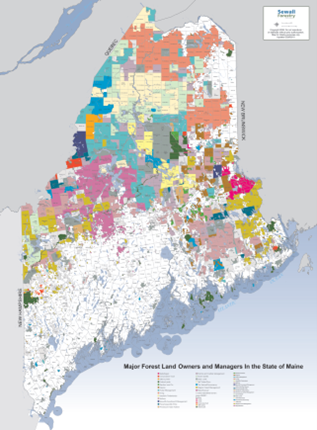
This dataset supports both an understanding of current ownership patterns and an analysis of historical ownership, allowing for evaluation of long-term land tenure trends. Key metrics of interest are the level of timberland ownership concentration among top owners, and the stability—or turnover—within this group.
Our dataset encompasses over 12 million acres of timberland in Maine, with approximately 65% (7.8 million acres) held by the top 10 landowners and 80% (9.7 million acres) among the top 20.
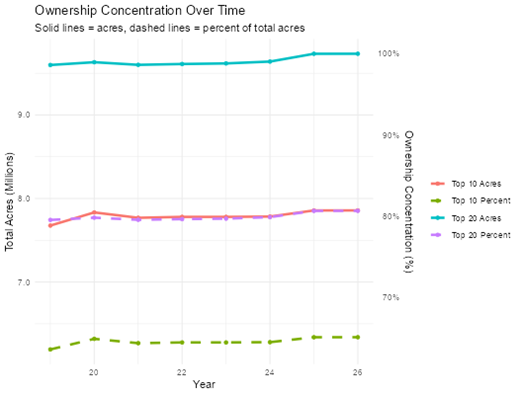
Timberland ownership concentration has remained remarkably stable over the past seven years. Aside from slightly elevated turnover in 2021—which may have been influenced by increased demand during the COVID-19 pandemic—our data shows only one ownership change per year within the top 20 landowners during this period. This stability is aligned with the long-term investment horizons typical of many timberland owners and managers.
Looking back to 1995, Maine’s timberland ownership has undergone substantial shifts, driven in part by global market conditions that contributed to the decline of vertically integrated industrial ownership and the subsequent rise of timberland investment management organizations.
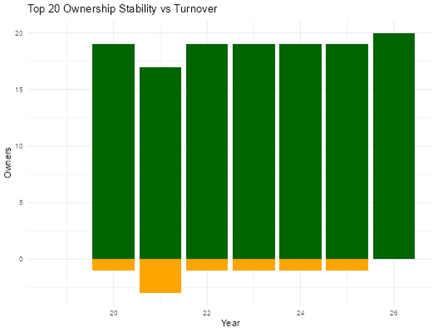
Orange (negative) = new entrants
In addition to ownership, we track management entities for larger timberland tracts. Each ownership group is classified into one of several ownership categories, including TIMO/REIT, logging contractor–turned–owner, private conservation, non-industrial, and family ownership.
The Maine Forest Land Owners and Managers database is updated regularly as significant timberland transactions occur across the state.
For more information or to inquire about access, please contact Joshua.oneill@sewallforestry.com
Josh O’Neill
Josh is a Natural Resource Consultant in our Technical Services group, where he applies his broad expertise to enhance the value of our services. His consulting work focuses on developing a deep understanding of forest information systems, using GIS and remote sensing technologies to create intelligent decision-support tools. He collaborates with diverse third-party service providers and crafts data-driven solutions tailored to client needs. Josh also manages Sewall Forestry’s proprietary Forestland Owners and Managers database, ensuring it remains a reliable resource for industry stakeholders.
Before joining our team, Josh served as a program assistant at Harvard University, where he managed complex relational databases in the Energy and Facilities sector. He has also taught lab courses on natural resource sampling and forest economics at UC Berkeley, leveraging research that now informs his innovative work as a consultant.
Josh earned his Master of Forestry from the University of California, Berkeley, in 2014, specializing in GIS and Remote Sensing. He also holds a Bachelor of Science degree in Forestry, with a minor in GIS, from the University of Vermont. As a Licensed Professional Forester, Josh is committed to creating strategic insights for forest investment and management decisions.