
One of the most compelling reasons to invest in forests is diversification.
Investors often measure diversification using correlation, which indicates how closely the returns of one asset move with another. Assets with low or negative correlations to stocks and bonds can help reduce overall portfolio risk and improve risk-adjusted returns.
When evaluating timberland correlations, however, there are a few important considerations.
Correlation Depends on Time Horizon
The first question to ask is: Over what period should correlation be measured?
For many publicly traded assets, investors often focus on relatively short periods because prices update continuously. Timberland is different. Much of the investment thesis relies on biological growth and forest management decisions that may take years, or even decades, to influence value.
In the southern US, meaningful management outcomes might emerge within 10 to 15 years. In northern forests, it may take 20 years or more before the effects of management decisions are fully reflected in harvest volumes, timber quality, or inventory measurements.
This is why short-term correlation studies can sometimes miss the bigger picture. Timberland is a long-term asset, and its diversification benefits should be evaluated over correspondingly long periods.
Correlations Are Not Fixed
Another important point is that correlations change over time.
Yet many analyses focus on just one recent period, such as the past five or ten years. Doing so assumes that the chosen period is the best estimate of the future. That may be true, but it should not be taken for granted.
A better approach is to examine rolling periods, which show how correlations have evolved across different market environments and economic cycles. Looking across multiple periods helps avoid the risk of drawing conclusions from an unusually favorable or unfavorable window.
What Timberland’s History Shows
The history of timberland and U.S. equities provides a good example.
Using the NCREIF Timberland Index and the S&P 500 Index:
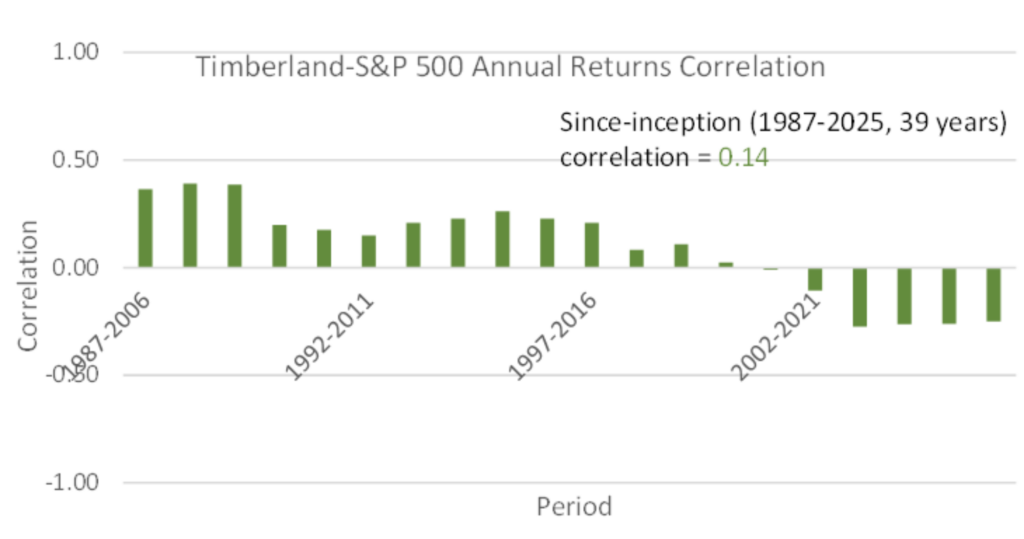
- The correlation over the most recent 20-year period is -0.25.
- Rolling 20-year correlations have ranged from -0.27 (2003-2022) to 0.39 (1988-2007).
- Since 1987, the full-period correlation has been 0.14.
The recent negative correlation is attractive from a diversification standpoint. However, the range of historical outcomes reminds us that positive correlations are also possible. Investors should understand both the recent experience and the longer-term record.
When a specific sub-period is highlighted, it is good practice to explain why that period is the most relevant for investment decisions. Otherwise, the full available history may provide the most objective perspective.
How Does Timberland Compare with Bonds?
Timberland is sometimes compared to fixed income investments because forests generate value through biological growth over time. Unlike bonds, however, investors have flexibility in deciding when to harvest and realize that value.
Since 1987:
- The correlation between the NCREIF Timberland Index and the Bloomberg Aggregate Bond Index has been 0.15.
- The correlation between bonds and U.S. equities has been 0.24 over the same period.
These relatively low correlations suggest that timberland has historically behaved differently from both stocks and bonds.
The Bottom Line
Correlation analysis is one of the most important tools for understanding timberland’s role in a portfolio. But the results depend heavily on the period selected.
Because forests are long-duration assets whose value is influenced by biological growth, management decisions, and economic cycles, investors should focus on longer time horizons and examine correlations across multiple periods rather than relying on a single snapshot.
The evidence suggests that timberland has historically maintained low correlations with both stocks and bonds, supporting its reputation as a valuable diversifier in long-term investment portfolios.
Peter D’Anieri
Peter serves as a Natural Resource Consultant for Sewall Forestry & Natural Resource Consulting, where his role encompasses economic and investment research. He has successfully led projects that assess the allocations of large timberland holdings for equity and has benchmarked property management responsibilities and costs. Additionally, Peter is frequently sought for his expertise in litigation projects.
Before joining Sewall Forestry & Natural Resource Consulting, he gained valuable experience in presenting investment opportunities, recommending portfolio placements, summarizing operating budgets, and conducting portfolio reviews. His background also includes forestry research, where he co-authored several technical reports and papers published in peer-reviewed journals and conference proceedings.
Peter has served on a firm’s investment committee, reviewing and approving farmland and timberland transactions across diverse regions, including the U.S. South and West, Canada, the U.S. Northeast, Australia, New Zealand, and Brazil. He holds the Chartered Financial Analyst designation, reflecting his commitment to professional excellence.
He earned his Master of Business Administration with Honors from the University of Notre Dame, a Master of Science in Forestry with an emphasis in Silviculture from Virginia Polytechnic Institute & State University, and a Bachelor of Science in Forestry and Wildlife Management from the University of Maine, graduating with High Distinction and Highest Honors.